

Yes — on housing, substantially so. A Bay Area household looking at Denver is usually looking at homes that cost somewhere between a half and a third of what the same profile of house costs at home. That part is not close, and no amount of nuance changes it. The nuance is everywhere else. Denver salaries do not follow Bay Area salaries down by the same proportion, Colorado taxes income in a way California does not, Colorado insurance has gotten expensive for reasons most transplants guess wrong about, and anyone who has owned in California for a long time is carrying a property tax advantage they cannot bring with them. Here is the honest version, with sources, so you can decide whether the move pencils for your household rather than for a headline. We ran the same exercise for another West Coast market in are Denver homes more affordable than Seattle.
- Home prices: Denver roughly two to three times cheaper
- Income tax: Colorado flat 4.40% vs California up to 12.30%
- Wages: Denver runs well below Bay Area pay — the gap narrows the arbitrage
- Insurance: higher here than transplants expect, and hail-driven, not wildfire
The housing gap is real and it is large
Start with the Census Bureau, because it measures every city the same way in the same period. In the 2020–2024 American Community Survey, the median value of an owner-occupied home was $616,000 in Denver, $929,900 in Oakland, $1,233,200 in San Jose and $1,394,500 in San Francisco. You can pull the Denver and San Francisco figures side by side on Census QuickFacts. Current transaction data tells the same story with sharper edges. The National Association of Realtors put the second-quarter 2026 median existing single-family price at $1,500,000 for the San Francisco–Oakland–Hayward metro and $2,050,000 for San Jose–Sunnyvale–Santa Clara, the two most expensive metros in the country. Over the same stretch, the Denver Metro Association of Realtors reported a July 2026 median close price of $605,000 across all residential, $660,000 detached and $380,000 attached. Comparing across those sources is approximate, since geographies and periods do not line up perfectly. But the shape is unambiguous: a Denver detached home runs roughly two to three times cheaper than a Bay Area equivalent, and the attached market here is in a different universe.
Where Denver gives some of it back
Income tax. Colorado applies a flat 4.40 percent to taxable income. California runs nine brackets from 1.00 to 12.30 percent, and the 9.30 percent bracket starts at $72,724 for a single filer and $145,448 for joint filers. A dual-income household that would be in California’s 9.3 percent bracket is looking at less than half that rate here. That is a real annual number, not a rounding difference. Property tax. Colorado taxes only a fraction of a home’s actual value. For 2026 the residential local government assessment rate is 6.8 percent after a 10 percent reduction on the first $700,000 of actual value, and mill levies apply to that assessed figure rather than the full price. California’s Proposition 13 caps the rate at one percent plus voter-approved bonded debt and limits annual assessment increases to two percent — but reassesses to market value on a change of ownership. Fuel and daily costs. For the week ending August 3, 2026, the Energy Information Administration put regular gasoline at $4.08 in Denver and $5.57 in San Francisco. That is roughly a dollar fifty a gallon, every fill, indefinitely.
Where the comparison gets less flattering
Wages do not fall as far as housing. This is the single most important correction to make before you build a budget. In the Bureau of Labor Statistics occupational wage survey for May 2025, the mean hourly wage across all occupations was $39.28 in the Denver metro and $57.32 in San Jose. In computer and mathematical occupations specifically, the gap is $62.33 against $97.15 — San Jose runs about 56 percent higher. So Bay Area homes cost roughly two to three times Denver’s, while Bay Area pay runs something closer to one and a half times. The arbitrage is genuine, but it is narrower than it looks, and it disappears entirely if your Denver offer is benchmarked to Denver rather than to your current salary. Median household income confirms it. Over the same Census period, median household income was $94,718 in Denver against $140,970 in San Francisco, $146,427 in San Jose and $101,600 in Oakland. Denver’s ratio of home value to household income is meaningfully better than any of those — but it is not a low ratio in absolute terms. Denver stopped being a cheap city some time ago. Insurance, and not for the reason you expect. Nearly every California transplant assumes wildfire is the Colorado insurance story. Along the Front Range it is not. The Colorado Division of Insurance reported in February 2026 that hail accounts for an average of 26 to 54 percent of a homeowner’s premium depending on the county, while wildfire ranges from 0.9 to 24.6 percent. In Denver proper, wildfire is a small share of premium and hail is the dominant driver. Statewide premiums have risen sharply in recent years, and this is a line item worth quoting before you write an offer, not after. The Proposition 13 basis you leave behind. If you bought in the Bay Area a decade or more ago, your assessed value has been climbing at a capped two percent a year while the market ran away from it. That advantage is attached to the property, not to you. Sell, and you buy into Denver at today’s full market basis with no legacy discount. For a long-tenured California owner, this can quietly erase a meaningful part of the apparent savings, and it is worth modeling with a CPA before you commit.
What your money actually buys here
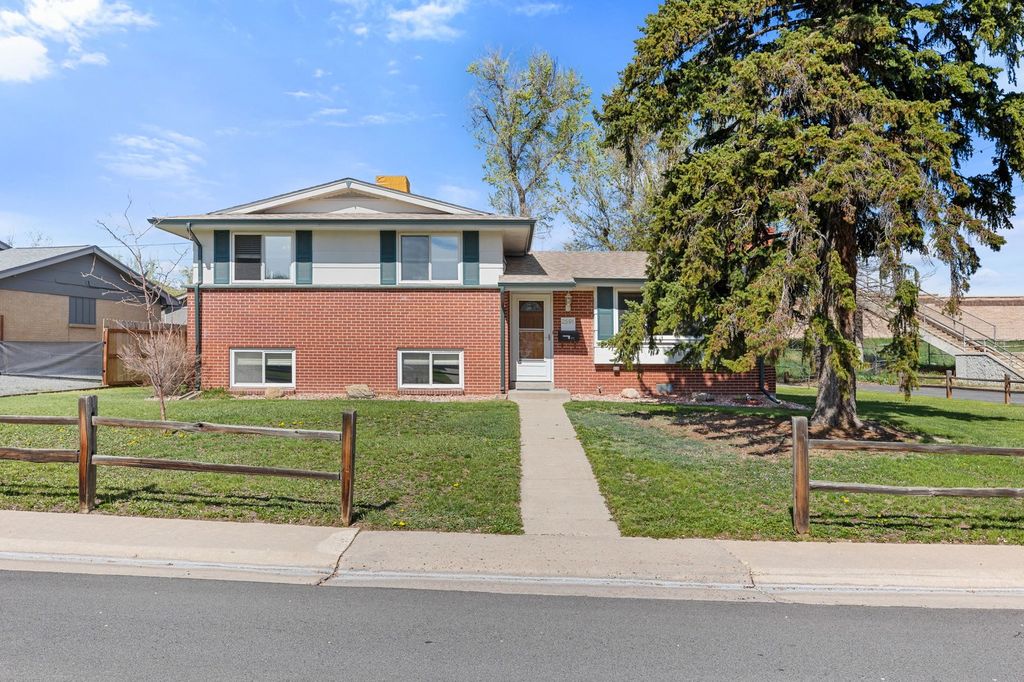
The practical translation is what most people actually want. A Bay Area budget that bought a small condo or a dated starter house in a long commute corridor generally buys a detached single-family home in an established Denver neighborhood, with a yard, a garage and a basement. Where that lands depends on what you valued at home. Buyers who loved walkable neighborhood commercial streets gravitate toward Berkeley and Tennyson, Platt Park and South Pearl, or Sloan’s Lake. Buyers who want space and mature trees look west to Wheat Ridge, Applewood and parts of Lakewood, where lots run notably larger within about ten miles of downtown. We mapped this out in more detail in best neighborhoods in Denver for San Francisco transplants. Two structural notes that catch West Coast buyers: basements are common here and are valued separately from above-grade square footage, so listed square footage is not directly comparable to a California figure. And much older Denver housing was built without central air, because the climate is dry — check rather than assume.
Frequently Asked Questions
Will I really cut my housing cost in half?
On purchase price, often more than half depending on which Bay Area county you are leaving and which Denver neighborhood you land in. On total monthly cost the gap narrows somewhat once Colorado income tax, homeowners insurance and the loss of a Proposition 13 basis are accounted for. Model your actual numbers rather than the ratio.
Are Denver salaries going to drop if I move?
Frequently, yes, if your employer benchmarks pay by location. Denver’s mean wage across all occupations runs about 17 percent above the national average; San Jose’s runs about 71 percent above. If you are keeping a Bay Area salary remotely, the arbitrage is much larger than if you are taking a Denver-benchmarked offer.
Is Colorado property tax really that much lower?
The effective burden is meaningfully lower, because the state taxes a fraction of actual value rather than the full amount. But Colorado reassesses residential property on a two-year cycle and the legislature has adjusted assessment rates repeatedly, so it is less predictable year to year than a Proposition 13 property. Your county assessor is the right source for a specific property.
How bad is homeowners insurance in Colorado?
Higher than most transplants expect, and rising. Hail is the primary driver along the Front Range rather than wildfire, which surprises people coming from California. Get a quote on a specific address during your inspection period, not after closing.
Does the cost of living outside housing favor Denver?
On some line items clearly, gasoline being the most obvious. On groceries and utilities the comparison is murkier and the available public data measures rates of change rather than price levels, so we would not put a number on it. Housing and income tax are where the difference is large enough to plan around.
What should I do before I start looking?
Get clear on three numbers: your realistic Denver income, an insurance quote for the kind of property you want, and what your California sale nets after tax. Run the housing side through the affordability calculator once you have them. Almost every relocation that goes sideways does so because one of those three was assumed rather than checked. This article is general information, not tax, legal, insurance or financial advice. Tax treatment, insurance pricing and income outcomes vary by household; please consult a qualified CPA, attorney or licensed insurance professional about your own situation. Figures cited come from the U.S. Census Bureau, the Bureau of Labor Statistics, the Energy Information Administration, the Colorado Division of Insurance, the National Association of Realtors and DMAR. Jason Sirois is a Denver Realtor with FORM at Compass Denver and an Applewood resident.