

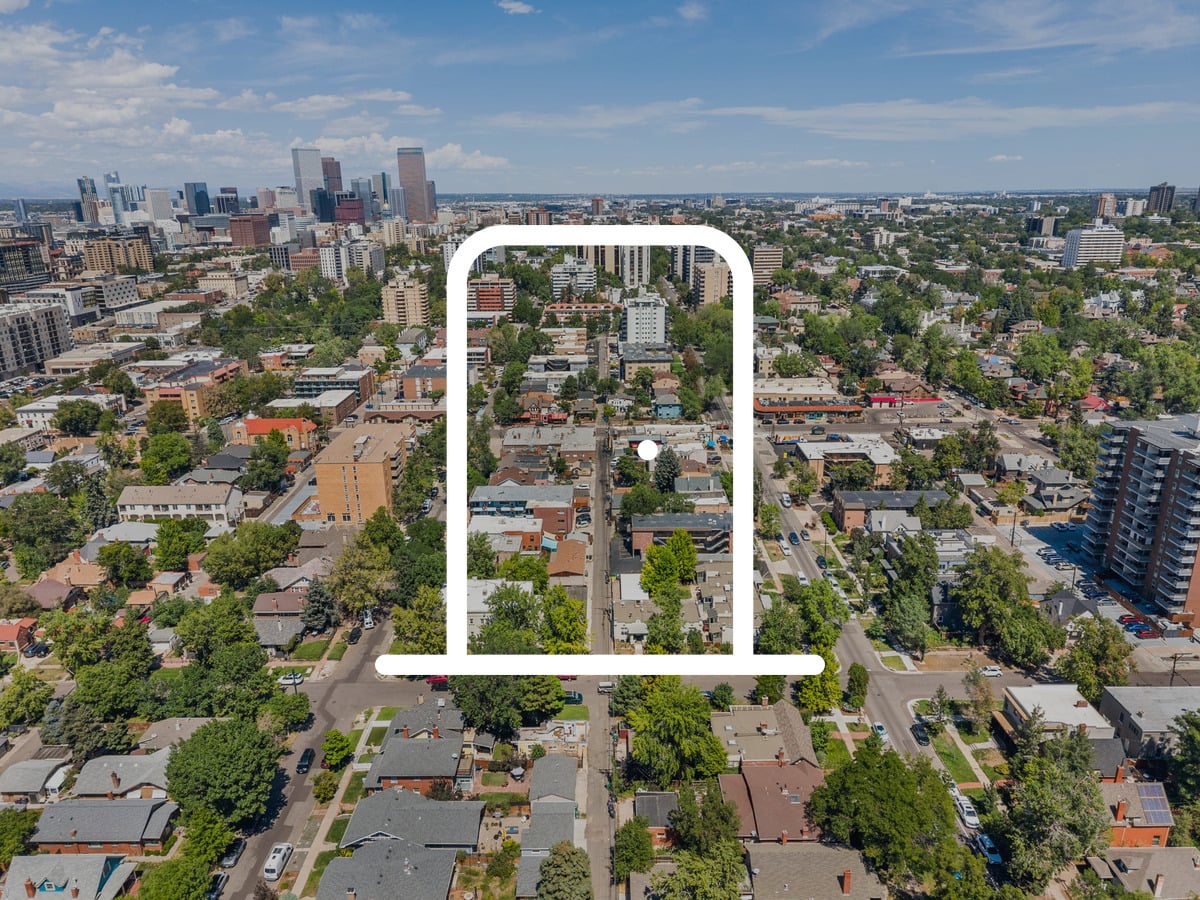
475 N Washington Street is a 1916 Craftsman half-duplex in Denver’s Alamo Placita historic district, where original oak built-ins and a wood-burning fireplace sit alongside a remodeled kitchen, updated systems, and a fenced brick patio a few blocks off Speer Boulevard.
Most buyers looking in central Denver are running the same trade-off in their heads. Old houses have the character, the woodwork, and the streets worth walking. They also tend to arrive with knob-and-tube wiring, a furnace older than the buyer, and a kitchen nobody has touched in forty years. The renovated ones, meanwhile, have often had the character sanded right out of them.
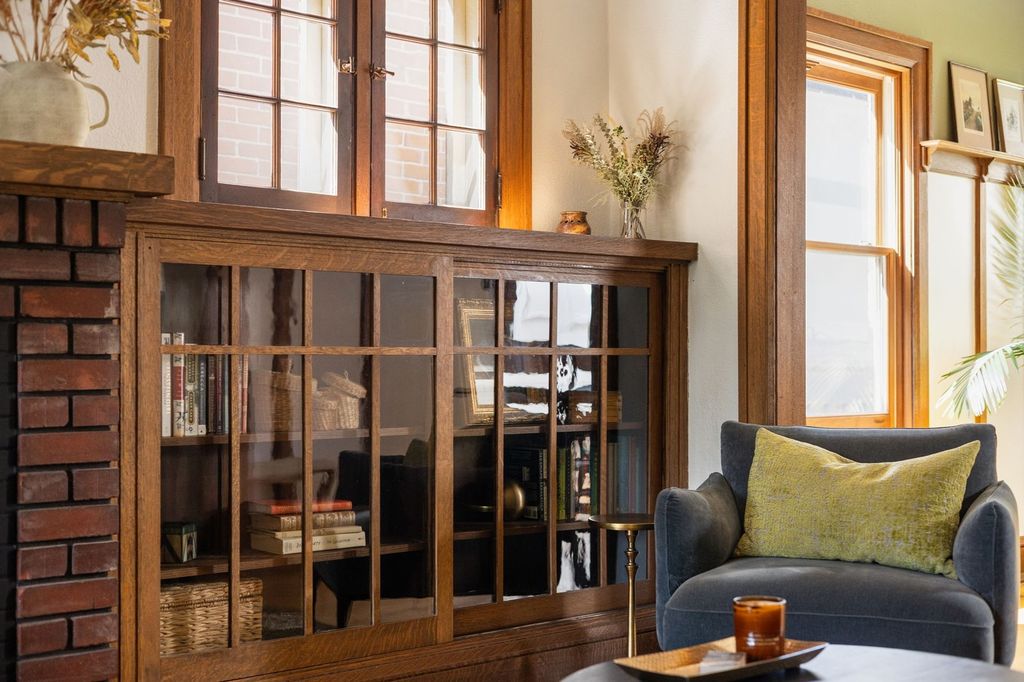
475 N Washington Street lands in the narrow band between those two outcomes. It is a Craftsman half-duplex built in 1916, and the parts that make a 1916 house worth owning are still there: quartersawn oak trim, a colonnade of leaded-glass built-in bookcases flanking a brick wood-burning fireplace, wide cased openings, and oak floors. The parts that make a 1916 house expensive to own have already been dealt with by somebody else.
It also sits in one of the quietly interesting neighborhoods in the city. Alamo Placita is small, it is a designated Denver historic district, and it is the first piece of Denver real estate Robert Speer ever bought.
What You Get at 475 N Washington Street
The home is a two-bedroom, one-bath half-duplex with 1,510 square feet above grade, set on a 3,259 square foot lot with a detached garage off the rear alley. The floor plan reads the way good Craftsman plans do: a living room with the fireplace and built-ins at its center, a wide opening into the dining room, then the kitchen, bedrooms, and bath off a short hall rather than a corridor. The primary bedroom carries dual closets, which is not a given in a house of this vintage.
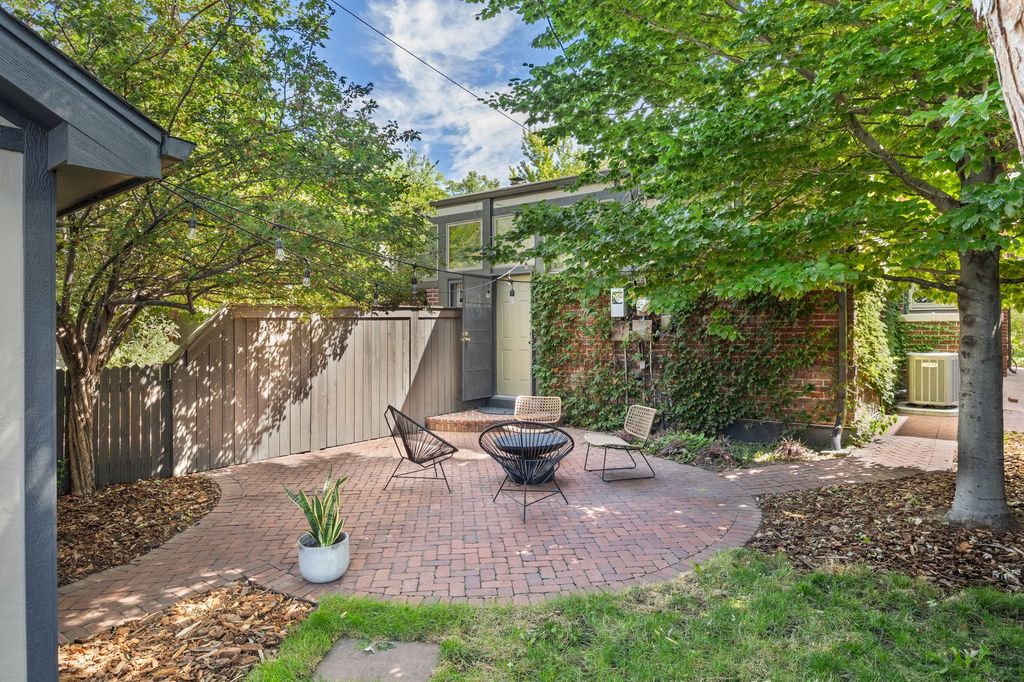
There is a full basement below, currently unfinished and used for laundry, storage, and workout space. Outside, the lot has been landscaped rather than merely maintained: a curved brick patio under mature shade trees, with string lights, a fire pit, and a strip of lawn running back to the garage. On a lot this size, that patio is effectively the second living room from May through October.
- Address: 475 N Washington St, Denver, CO 80203
- Offered at: $599,900
- Beds and baths: 2 bedrooms, 1 bath
- Size: 1,510 square feet above grade, plus a full unfinished basement
- Built: 1916, Craftsman half-duplex
- Lot: 3,259 square feet with a fenced brick patio
- Parking: detached garage off the alley
- HOA: none; annual taxes roughly $2,918
Updated Without Being Stripped
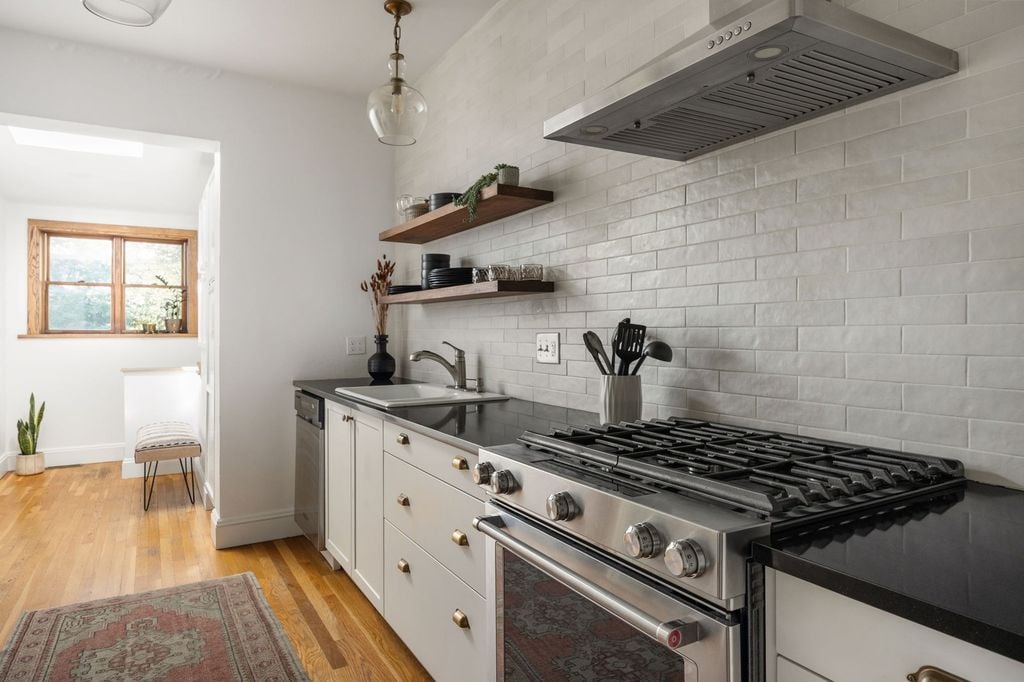
This is the part that separates a project from a move-in. The kitchen has been remodeled with white shaker cabinetry, dark stone counters, a gas range under a stainless hood, handmade-look subway tile, and walnut open shelving. The bathroom has been renovated in the same register, with a period-appropriate patterned tile floor, subway tile surround, and a wood vanity that reads as furniture instead of as a fixture.
Behind the finishes, the electrical and plumbing have been updated, the windows are newer, and the HVAC is new. Those four line items are exactly the ones that turn a charming old house into a six-figure surprise, and finding them already handled makes this a different asset than the untouched house down the block.
What was not done matters just as much. Nobody ripped out the colonnade, painted the oak, or swapped the wood-burning fireplace for an insert. That restraint is effectively impossible to reproduce after the fact.
Alamo Placita, and Why This Block Reads the Way It Does
Alamo Placita is a compact neighborhood bounded roughly by Sixth Avenue on the north, Speer Boulevard on the south, Downing Street on the east, and Pennsylvania Street on the west. Moses Hallett bought the prairie quarter-section along Cherry Creek in 1864, platted as the Arlington Park Addition. Robert Speer, later Denver’s first home-rule mayor and the man the boulevard is named for, made it his first major real estate investment and lived on Clarkson Street through the 1890s.
For roughly a decade the site held an amusement park: Arlington Park opened on the Fourth of July in 1892, reopened as Chutes Park after the Silver Crash of 1893, and burned for the last time in 1902. The land went back to housing, and by 1930 about ninety percent of the buildings standing in the district today were already built.
Denver City Council designated the area a historic district in 2000, with a period of significance running from 1889 to 1942. The character-defining features the city documented are the reason the streets feel coherent: one- and two-story brick in varied reds and tans, deep front setbacks, tall chimneys, one-story porches, wide sandstone sidewalks with mature tree lawns, and garages tucked onto the alleys. 475 N Washington checks essentially every one of those boxes, which is the point.
Getting Around From Fifth and Washington
The practical appeal here is position. Speer Boulevard and the Cherry Creek Trail are a short walk south, putting a continuous bike route to downtown and Cherry Creek North at the end of the block. Downtown is close enough that the aerial photos of this listing have the skyline sitting directly above the rooftops.
Sixth Avenue anchors the north edge with its restaurants and small retail, Governor’s Park and the shops along Seventh sit a few blocks west, and Alamo Placita Park, laid out by S.R. DeBoer in 1927, is just southeast. Cheesman Park, Wash Park, and Cherry Creek are each a short drive. The Cheesman Park community page covers the neighborhood immediately northeast if you are comparing blocks.
Who This Home Fits, and Who It Does Not
This is a strong fit for a buyer or a couple who want architecture and location over square footage: a first-time buyer priced out of a detached historic home in the same district, a downsizer who wants to walk to dinner, or someone who works downtown and is finished with the commute. It also suits a buyer who wants an old house without wanting a project.
It is not the right house for everyone. Two bedrooms and one bath is a real constraint, and no amount of charm changes that math for a growing family. It is a half-duplex, so you share a wall, and the lot is small enough that a large dog or a serious gardener would feel it. The path to a second bath and a third sleeping space runs through the unfinished basement, a permit, and a contractor.
There is also the historic district to account for. Landmark designation protects the streetscape you are paying for, but exterior alterations visible from the street go through design review: a feature if you are buying the block as much as the house, a friction if you were planning a pop-top. Jason Sirois, a Denver Realtor with FORM at Compass Denver, can walk through what that review involves before you write an offer.
Central Denver’s pre-war stock does not trade as one market, so a district-level average tells you little about any one house. DMAR publishes metro-wide trends monthly, but the useful comparison here is against the handful of genuinely similar properties nearby. Get in touch to arrange a private showing.
Frequently Asked Questions
Is 475 N Washington Street in the Alamo Placita historic district?
Yes. The address sits inside the Alamo Placita Historic District, designated by Denver City Council in 2000, covering the area roughly between Sixth Avenue, Speer Boulevard, Downing Street, and Pennsylvania Street. Its period of significance runs from 1889 to 1942, and this 1916 Craftsman falls inside it.
What does buying in a Denver historic district mean for remodeling?
Interior work is generally unaffected. Exterior changes visible from the street, including windows, porches, and additions, go through Denver’s landmark design review before permitting. Ordinary maintenance and in-kind repair are usually straightforward; a pop-top or a front-facing addition takes more planning and a longer timeline.
Is a half-duplex the same as a condo or a townhome?
No. A half-duplex is typically fee-simple ownership of one side of a two-unit building, including the land under it, with a shared party wall and usually no association or common area, which is the case here. That is a different ownership structure, and often a different financing conversation, than a condo.
How much usable space does the basement add?
The basement runs the footprint of the house and is currently unfinished, serving as laundry, storage, and workout space. It is not counted in the 1,510 above-grade square feet. Finishing it is the obvious way to add a bathroom or a third sleeping space, subject to ceiling height, egress, and permitting.
How walkable is Alamo Placita?
Very. The Sixth Avenue restaurant corridor is at the north edge, the shops along Seventh and Governor’s Park are a few blocks west, and the Cherry Creek Trail is a short walk south, connecting to downtown by bike. Most daily errands from this block are walkable or a short ride.
Are there HOA dues on this property?
No. The listing carries no HOA fee, and annual property taxes are approximately $2,918. Exterior maintenance, the yard, and the detached garage are the owner’s responsibility, as is typical for a fee-simple half-duplex in central Denver.
This article is general information about a specific property and neighborhood, not legal, tax, or financial advice. Listing details including price, square footage, and availability are subject to change, and tax figures vary by assessment year. Confirm current terms with the appropriate professional before deciding.