


No swimming is allowed in Sloan’s Lake, and Denver health officials advise people and pets to stay out of the water. Dogs must stay leashed in the park, and the lake often carries blue-green algae in summer, so keep dogs out of the water and away from scum or foam.
Sloan’s Lake Park is a big part of daily life for many West Highland owners. The park’s north shore runs along West 26th Avenue, about three blocks south of West Highland’s southern edge at West 29th Avenue, and its 2.5-mile loop path is one of the most used walking, running and dog-walking routes in Northwest Denver.
That makes the water itself a common question. People see paddleboards and dragon boats on the lake, hear about algae warnings and fish die-offs, and want to know what is actually allowed and what is sensible. Buyers looking at homes near the lake ask the same thing, often alongside questions about the city’s plan to restore it.
Jason Sirois is a Denver Realtor with FORM at Compass, whose office is at 1900 W 32nd Ave in Northwest Denver. This post covers Denver’s rules for swimming and dogs at Sloan’s Lake, the lake’s algae history, what health officials recommend, what the $50 million restoration aims to change, and where to check current conditions before you go.
Can you swim in Sloan’s Lake?
No. Denver’s park rules say no swimming is allowed except in swimming pools, and that applies to Sloan’s Lake like every other city park lake. FOX31 reported in 2024 that the reasons include no lifeguards and runoff bacteria such as E. coli.
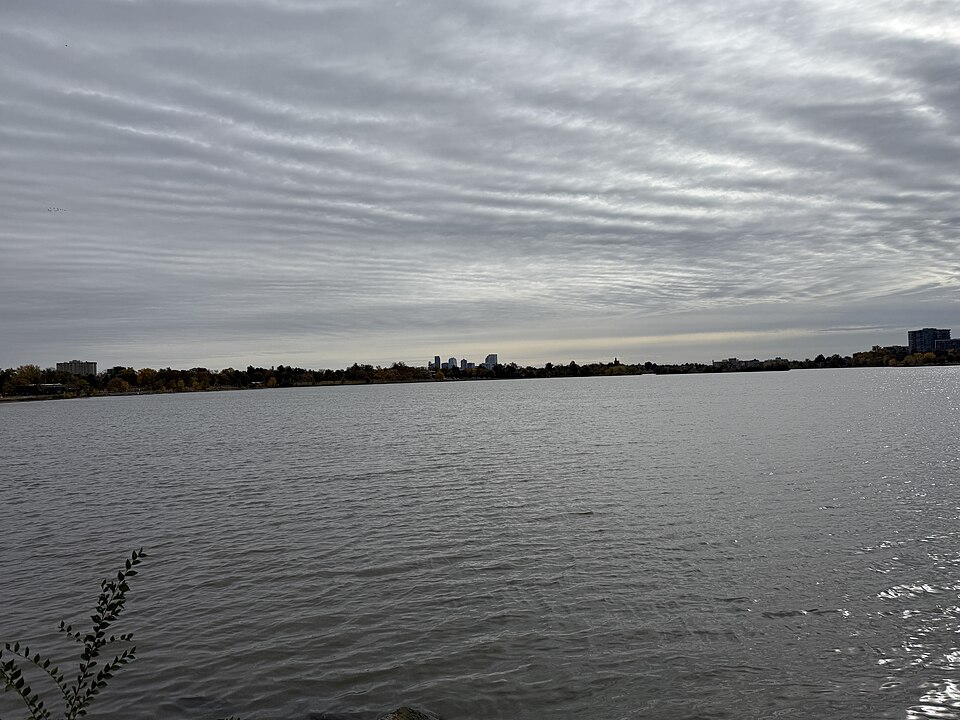
Sloan’s Lake from the west shore, October 24, 2026. Photo: Dough4872, CC BY-SA 4.0, via Wikimedia Commons.
The Denver Department of Public Health and Environment goes further. Its guidance on recreating in Denver’s lakes and streams says it does not recommend swimming, wading or playing in city lakes or streams. The same page says Sloan’s Lake is sampled monthly from May through October, typically has high levels of blue-green algae in summer, and that people and animals should avoid contact near the marina, boat ramp and dock, and the shallow areas between them.
Boating is a different matter. Denver’s boating rules allow hand-launched and wind-powered boats on city lakes with required safety equipment, and motorized boats are not allowed. If you paddle, plan not to end up in the water, and rinse off if you do.
Can dogs go in the water at Sloan’s Lake?
Denver’s park rules require dogs and pets to be on a leash and under physical control at all times, and there is no off-leash area at Sloan’s Lake. The nearest city dog park on Denver’s list is Berkeley Dog Park, at West 46th Avenue and Sheridan Boulevard, where dogs can be off leash once inside.
The park rules do not spell out whether a leashed dog may wade in. The health guidance is clearer: city officials advise people and animals to avoid contact with the water in the areas listed above, and the state’s advice for any water that might have a bloom is to keep pets away. In practice, that means keeping dogs on the path and out of the lake, especially from late spring through fall.
Leash fines are real. Colorado Sun fact-checkers reported in March 2026 that park ranger fines run $100, $250 and $500 for first, second and third offenses within a year, and the city code allows up to $999.
How often has Sloan’s Lake had algae problems?
Blue-green algae, also called cyanobacteria, can produce toxins that sicken people and can be deadly to dogs. Sloan’s Lake has had repeated trouble with it, mainly because it is shallow and warm and collects nutrient-rich sediment from more than a century of stormwater runoff. Denverite reported in January 2026 that the lake’s average depth is about 3.5 feet, with a maximum of about 8 feet, compared with more than 10 feet historically.
| Date | What happened | Source |
|---|---|---|
| July 10, 2021 | City warns pet owners not to let pets drink the water; signs posted | CBS Colorado |
| July 22, 2021 | Lake closed to all water contact, including boating and fishing | CBS Colorado |
| September 2021 | Lake reopened after bloom and toxin levels dropped | CBS Colorado, Sept. 10, 2021 |
| 2022 onward | Annual phosphorus treatments begin | City of Denver |
| July 2024 | About 2,000 fish die during an algae and low-oxygen event after a run of 100-degree days | The Colorado Sun |
| Summer 2024 | Floating wetlands added | City of Denver |
| July-August 2025 | Lake closed to permitted events over algae concerns; Dragon Boat Festival moved to September | Denver7, Aug. 1, 2025 |
| Sept. 2, 2026 | City announces a $50 million restoration plan | Axios Denver, Denverite |
We did not find a Denver algae advisory for Sloan’s Lake reported for summer 2026. That does not mean the water was clear all season. Conditions change week to week, and the city posts notices at the lake when testing finds toxins at levels of concern.
What should I do if my dog gets into algae-tinged water?
The Colorado Department of Public Health and Environment’s toxic algae guidance sums it up as “when in doubt, stay out.” Blooms can look like pea soup, spilled paint or floating mats of foam, but only testing confirms whether algae is toxic. If a dog does get in:
- Get the dog out of the water right away and keep it from licking its fur or paws.
- Rinse it with clean, fresh tap water as soon as possible.
- Watch for drooling, vomiting, diarrhea, low energy, loss of appetite, stumbling or tremors.
- Call a veterinarian if symptoms appear or the dog may have swallowed water or algae.
For people, CDPHE advises showering or rinsing off promptly and seeing a provider if symptoms develop. Questions about a specific Denver lake can go to 311.
Will the $50 million restoration make Sloan’s Lake swimmable?
Not on any announced timeline. The plan Mayor Mike Johnston announced on September 2, 2026 would dredge sediment, rebuild and restore the shoreline, add green infrastructure to filter stormwater and create deeper fish habitat. Funding is set to come from up to $40 million in St. Anthony urban redevelopment tax increment, $5 million from the Vibrant Denver bond and $5 million from the city’s wastewater fund. The mayor’s stated goal was a lake that is “fall-in-able, if not swimmable.”
At the September announcement, the plan still needed approval from the Denver Urban Renewal Authority board and City Council. Contracting and federal permits were expected in 2027, with construction starting in 2028. Our earlier post on how the Sloan’s Lake restoration could affect West Highland covers the timeline and construction questions in more detail. Until a project changes city rules, the no-swimming rule stands.
For more on the neighborhood around the lake, see our West Highland community page.
Frequently Asked Questions
Is swimming allowed in Sloan’s Lake?
No. Denver’s park rules allow swimming only in swimming pools, and city health officials do not recommend swimming, wading or playing in any city lake.
Can my dog swim in Sloan’s Lake?
Dogs must be leashed in Denver parks, and city and state health guidance is to keep pets away from water that may have algae. Sloan’s Lake typically has high blue-green algae levels in summer, so keep dogs out of the water.
Is there an off-leash dog park at Sloan’s Lake?
No. The closest city dog park on Denver’s list is Berkeley Dog Park at West 46th Avenue and Sheridan Boulevard.
How do I know if there is an algae warning at Sloan’s Lake?
Look for posted notices at the lake, which the city puts up when testing finds toxins at levels of concern, and call 311 with questions. The lake is sampled monthly from May through October.
Can I kayak or paddleboard on Sloan’s Lake?
Denver allows hand-launched and wind-powered boats on city lakes with required safety equipment. Motorized boats are not allowed. Avoid contact with the water, especially near the boat ramp and docks.
Why does Sloan’s Lake get algae blooms?
The lake is shallow, about 3.5 feet deep on average, so it warms quickly, and decades of stormwater sediment add nutrients that feed algae.
When will the Sloan’s Lake restoration start?
As announced in September 2026, construction is expected to start in 2028 after approvals, contracting and federal permitting in 2027.
This post is general information, not medical, veterinary or legal advice. Park rules, advisories and project timelines can change; check with Denver Parks and Recreation, Denver Public Health and Environment or 311 for current conditions.
Thinking about a home near Sloan’s Lake? Jason Sirois and the FORM team at Compass Denver can walk you through the neighborhood blocks around the park and what is changing nearby.